How to Connect AI to Your Existing CRM, POS, and Business Platforms
One of the biggest misconceptions about AI adoption is that you need to rip and replace your existing tech stack. Start over with new platforms. Migrate all your data. Retrain your entire team. That narrative keeps a lot of business owners stuck — they know AI could help, but the imagined cost and disruption of switching systems feels prohibitive.
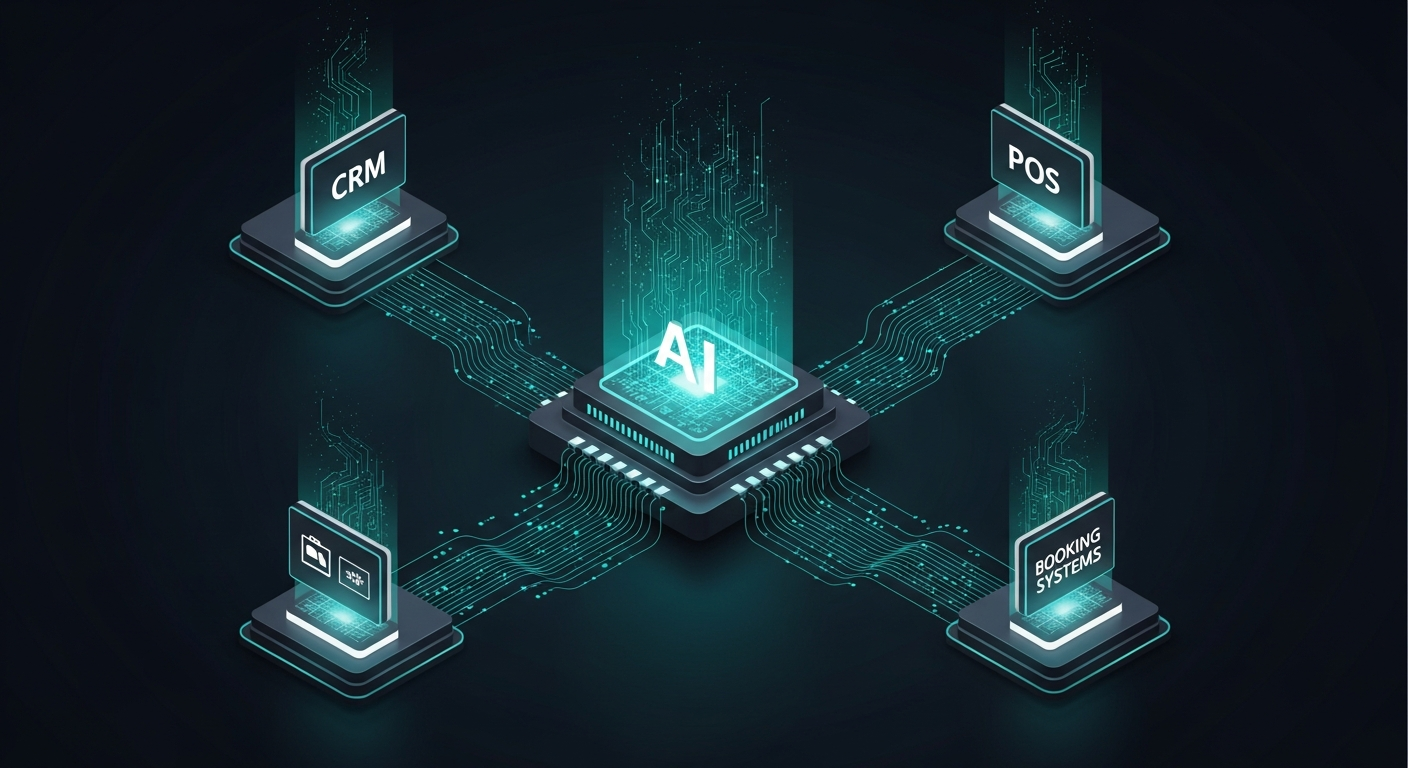
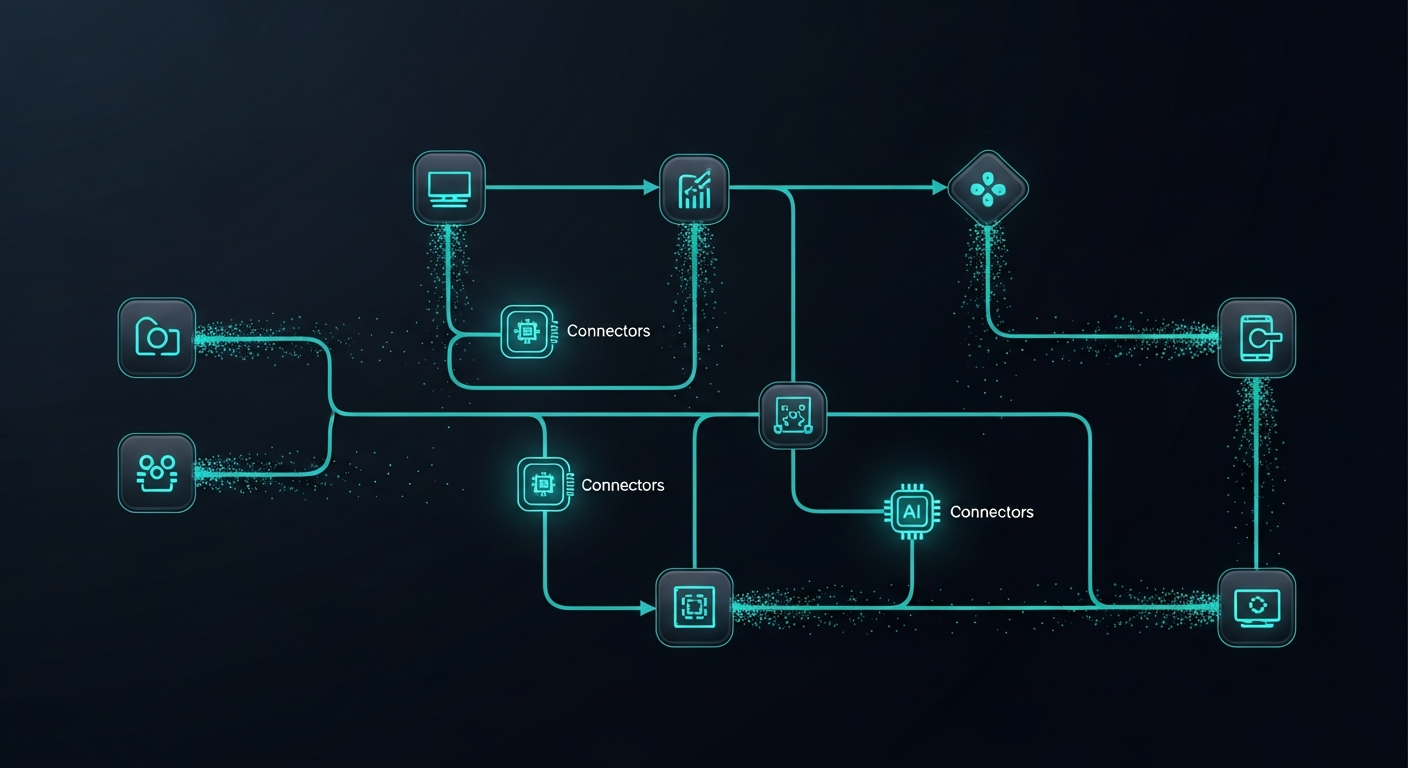
Here's the reality: the most effective AI implementations don't replace your current tools. They connect to them. Your CRM stays. Your POS stays. Your booking platform stays. AI sits between these systems, automating the manual work your team currently does to move data between them, and surfacing intelligence that none of your individual tools can produce on their own.
This is the approach that delivers the fastest ROI with the least disruption. And for most businesses, it's significantly more valuable than switching to a 'smarter' platform — because the intelligence comes from connecting what you already have, not from any single tool.
Why Integration Beats Replacement
Before we get into the specifics, it's worth understanding why connecting existing tools to AI is almost always better than replacing them with AI-native alternatives.
First, your team already knows your current tools. The CRM your sales team has used for three years has their workflows, their data, their muscle memory built in. Switching to a new platform means months of reduced productivity while everyone learns new interfaces and rebuilds their processes. Even if the new tool is objectively better, the transition cost — in time, errors, and morale — is significant.
Second, your data lives in your current systems. Years of customer records, transaction histories, interaction logs, and notes. Migrating that data is never as clean as vendors promise. Fields don't map perfectly. Historical data loses context. Custom fields get dropped. Some data is simply lost in translation.
Third, and most importantly, the AI advantage often comes from cross-system intelligence — insights that emerge when data from multiple systems is combined and analyzed together. No single platform can provide this, because no single platform has all your data. The value isn't in any one tool being smart. It's in making the connections between tools intelligent.
CRM + AI: Customer Intelligence That Anticipates Needs
Your CRM holds the history of every customer relationship — purchase records, communication logs, support tickets, notes from sales calls. But most teams use their CRM as a record-keeping system, not an intelligence system. They manually review customer files before calls, rely on memory for relationship details, and make outreach decisions based on gut feel rather than data.
When AI is connected to your CRM, it transforms static records into dynamic intelligence. Before every customer interaction, AI can generate a brief — their complete purchase history, communication preferences, any open issues, upcoming milestones (anniversary of becoming a customer, upcoming renewal date), and predicted needs based on their behavior patterns. This brief arrives in your team's inbox or dashboard automatically, no manual review required.
AI can also identify patterns that humans miss in large datasets. Which customers are showing signs of churn (decreasing engagement, longer gaps between purchases)? Which are likely ready for an upsell (they've been browsing higher-tier services on your website)? Which haven't been contacted in a while and are at risk of feeling neglected? These signals exist in your CRM data, but without AI, they're buried in thousands of records that no human team can actively monitor.
The practical impact: your team walks into every customer interaction prepared, your at-risk customers get proactive outreach before they leave, and your upsell opportunities are identified and acted on systematically rather than randomly.
POS + AI: Turning Transaction Data into Business Strategy
Your point-of-sale system holds a goldmine of data that most businesses barely scratch the surface of. Transaction histories, purchasing patterns, time-of-day trends, product combinations, seasonal variations — it's all there, but extracting actionable insights from raw POS data requires analysis that most business owners don't have time for.
AI can analyze your POS data continuously and surface the insights that matter. What are your most profitable products (not just highest-selling, but highest-margin when you factor in all costs)? Which product combinations are frequently purchased together, suggesting bundling or upsell opportunities? What days and times are your peak and off-peak periods, and how should staffing and inventory align?
For retail businesses, AI can predict inventory needs with remarkable accuracy — analyzing historical sales velocity, seasonal patterns, and external factors to generate purchase orders that minimize both stockouts and overstock. For restaurants, it can identify menu items that are underperforming relative to their cost and suggest pricing or positioning changes.
One of our clients — a multi-location retail business — connected AI to their existing POS and discovered that a product they'd been considering discontinuing was actually their highest-margin item when purchased as part of a specific bundle. They hadn't seen the pattern because it only emerged when analyzing thousands of transactions across locations simultaneously.
Booking Platform + AI: The Automated Customer Journey
When a new booking comes in — through a platform like OtterBooking (otterbooking.com) — it typically kicks off a series of manual tasks. Look up the customer in the CRM. Check if they've been before. Review their history. Send a confirmation email. Maybe send prep instructions. Assign the right team member. Block off the right amount of time. After the appointment: send a follow-up. Ask for a review. Schedule the next appointment. Update the CRM.
Most of these steps are done manually by an admin or the business owner themselves. And most of them follow the same pattern every time — they're just different enough in details that a simple template doesn't quite work.
AI integration solves this perfectly. When a booking comes in, AI automatically pulls the customer's complete history from your CRM, identifies what type of appointment it is, assigns it to the best team member based on expertise and availability, sends personalized pre-appointment communications that reference the customer's specific needs, and prepares a brief for the service provider. After the appointment, it triggers a personalized follow-up, requests a review at the optimal time, and recommends a next-appointment timeframe based on the customer's typical frequency.
The entire customer journey — from booking to follow-up — happens automatically, with each touchpoint personalized based on real customer data. The experience feels high-touch and personal. The operational cost is near zero.
Email Marketing + AI: Personalization at Scale
Traditional email marketing is a blunt instrument. You segment your list into a few groups, write a generic email for each group, and blast it out. Open rates hover around 20%. Click-through rates around 2-3%. Most people on your list are getting content that's only tangentially relevant to them.
AI-connected email marketing changes this fundamentally. Instead of sending the same email to a segment of 500 people, AI can generate personalized content for each recipient based on their purchase history, browsing behavior, engagement patterns, and predicted interests. The subject line, the body copy, the recommended products or services, even the send time — all optimized for each individual recipient.
The results are dramatic. AI-personalized email campaigns typically see 2-3x higher open rates and 3-5x higher click-through rates compared to standard segmented campaigns. Conversion rates go up because people are seeing content that's actually relevant to them. Unsubscribe rates go down because people stop receiving emails that feel like spam and start receiving emails that feel like helpful recommendations.
How to Think About Your Integration Strategy
The key to a successful AI integration project isn't technical — it's strategic. The technology to connect virtually any business platform to AI exists today. The question is: which connections will create the most value for your specific business?
Start by mapping how data flows between your systems today. Where is data being manually transferred from one system to another? Where are your team members looking up information in one system to use in another? Where are decisions being made based on partial information because the relevant data lives in a different tool?
Each of these friction points is a potential integration opportunity. Prioritize them by impact: which ones affect the most transactions, the most customers, or the most team hours? That's where you start.
At GrowWithOtter, we start every integration project with a thorough audit of your current tech stack and workflows. We map how data flows (or doesn't flow) between your systems and identify the highest-leverage connection points. Our AI Tool Integration projects range from $2,500 to $10,000 depending on complexity, with monthly care plans starting at $197 for ongoing maintenance and optimization.
Common Concerns About AI Integration
Two concerns come up frequently when businesses consider AI integration, and both are worth addressing directly.
The first is data security. When AI sits between your business systems, it processes sensitive customer data — purchase histories, contact information, communication records. This is a legitimate concern, and the answer matters. Any reputable AI integration provider should be able to explain exactly how your data is processed, where it's stored, and what security measures are in place. At GrowWithOtter, we build integrations that process data in real-time without storing sensitive customer information in additional databases. Your data stays in your existing systems — the AI reads from them, generates intelligence, and delivers results without creating a new data liability.
The second concern is reliability. What happens if the integration breaks? If your team has come to depend on AI-generated customer briefs before every call and the system goes down, are they suddenly blind? This is why we build every integration with graceful degradation — if a connection is interrupted, your underlying systems continue to function normally. You don't lose data or functionality; you just temporarily lose the AI layer on top of it. And our monitoring catches issues before they impact your workflow, typically resolving them before your team even notices.
The businesses that invest in AI integration now are building a structural advantage that compounds over time. Every month of connected data makes the AI smarter, the insights more accurate, and the automations more valuable. Waiting doesn't just mean missing out on current benefits — it means falling behind competitors who are already accumulating that advantage.
You don't need to replace your tools. You need to connect them. And once they're connected through AI, the intelligence that emerges from your own business data will transform how you operate.
Ready to put these ideas to work?
Book a $500 AI audit and we'll map out exactly where AI and automation can create the most leverage for your business.
Book an audit →