Is Your Website Searchable by AI? If Not, Your Business Has 3 Years
Something is happening to search right now that most business owners don't fully understand yet. And by the time they do, it may be too late to catch up.
The way people find businesses online is undergoing the biggest structural shift since Google replaced the Yellow Pages. AI-powered search — through ChatGPT, Google AI Overviews, Perplexity, Siri, and dozens of other AI systems — is rapidly replacing the traditional search experience. And the businesses whose websites can't be read, understood, and cited by these AI systems are being erased from discovery.
This isn't speculation. This is happening right now, backed by hard data. And the window to adapt is measured in years, not decades.
The Numbers Tell the Story
Let's start with what the data actually shows, because the scale of this shift is staggering.
ChatGPT now has 900 million weekly active users as of early 2026, up from 800 million just five months earlier. It processes 2 billion queries per day and receives 5.4 billion monthly visits — nearly triple Bing's 1.9 billion. It's now the fifth most-visited website on the planet, and it holds over 80% of the AI chatbot market.
Perplexity, the AI-native search engine, processed 780 million search queries in a single month in mid-2025 — up from 230 million less than a year before. That's a 3.4x increase in under twelve months.
Meanwhile, Google's US market share has dropped from 93.37% in February 2023 to 85.67% by late 2025. That may sound like a small decline in percentage terms, but in a market where billions of searches happen daily, those percentage points represent hundreds of millions of queries shifting to AI platforms.
And here's the projection that should make every business owner pay attention: Gartner predicts that by the end of 2026, traditional search volume will drop by approximately 25%, with AI chatbots and virtual agents absorbing that demand. Other forecasts suggest AI-powered searches will grow by 35% annually, reaching 14% or more of total search market share by 2028. Some models project AI-native search could hit majority share by 2030.
The Click-Through Collapse
But the raw market share numbers only tell half the story. The more immediate threat to your business is what's happening to clicks — the actual traffic that flows from search results to your website.
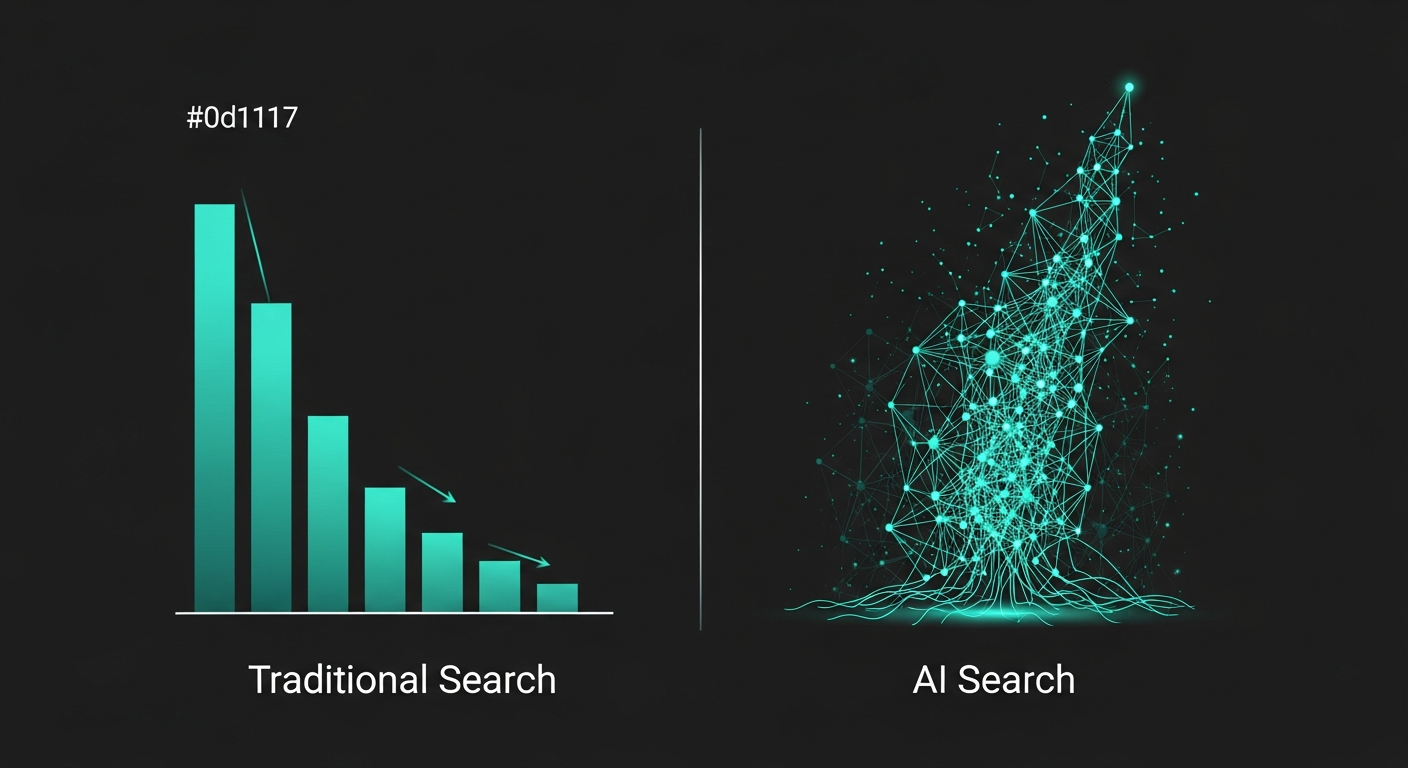
As of 2025, 64% of all Google searches end without a single click to an external website. That number was significantly lower just a few years ago. The reason? AI summaries. When Google shows an AI Overview at the top of search results, it answers the user's question right there. No click needed.
The impact is dramatic. When AI summaries appear in Google search results, click-through rates for the top organic results drop by 34.5%. Only 8% of users click on standard listings when an AI summary is present, compared to 15% without — nearly a 50% decline in clicks.
In Google's newer AI Mode — which already has over 100 million monthly active users — the zero-click rate hits 93%. Ninety-three percent. That means for every 100 searches in AI Mode, only 7 result in someone actually visiting a website.
For publishers and businesses dependent on organic traffic, the damage is already severe. Google search traffic to publishers declined by 33% globally between November 2024 and November 2025. Mid-sized websites — the ones ranked 100 to 10,000 by traffic — experienced the worst declines. News, health, and service-based sites were hit hardest.
Here's what this means in plain terms: even if your website ranks well in traditional Google results, the number of people actually clicking through to your site is falling — fast. And it's going to keep falling as AI-generated answers become the default experience.
So Where Is the Traffic Going?
The critical question for business owners isn't just 'where is traffic declining?' — it's 'where is it growing?'
The total search pie is actually getting bigger. Combined usage of search engines and AI tools has increased by 26% worldwide and 16% in the US. People aren't searching less. They're searching differently — and in new places.
AI referral traffic to websites grew roughly sevenfold between early 2024 and mid-2025. Referral traffic specifically from ChatGPT grew 206% between January 2025 and January 2026. ChatGPT now drives 87.4% of all AI referral traffic to websites.
And here's the number that really matters: AI search traffic converts at 14.2%, compared to Google's 2.8%. That means a visitor who comes to your website from an AI recommendation is five times more likely to become a customer than one who clicks a Google search result.
Think about what that means. Even if AI sends you fewer total visitors than Google does today, those visitors are dramatically more valuable. The businesses that figure out how to be visible to AI systems aren't just maintaining their traffic — they're getting better traffic.
But here's the catch: AI systems only recommend businesses they can actually understand. And most business websites are invisible to AI.
Why AI Can't See Most Business Websites
When a human visits your website, they can look at the layout, read the text, interpret the images, and figure out what your business does. AI systems don't work that way. They need structured, machine-readable information to understand your business with enough confidence to recommend it.
Most small business websites fail this test completely. Here's why:
No structured data (schema markup). Schema markup is code embedded in your website that tells AI systems exactly what your business is, what services you offer, where you're located, what your hours are, what your pricing looks like, and what customers say about you. Without schema markup, AI systems have to guess — and they don't guess. They skip you and recommend a business that gives them clear data.
According to recent analysis, fewer than 30% of small business websites have any schema markup at all. Even fewer have comprehensive schema that covers services, reviews, FAQ content, and local business details. If your website doesn't have it, you're invisible to the fastest-growing discovery channel in the world.
Thin or unstructured content. AI systems need substantive, well-organized content to understand what your business does. A homepage with a hero image, a tagline, and a contact form doesn't give AI enough to work with. AI needs detailed service descriptions, FAQ pages that answer real customer questions, blog content that demonstrates expertise, and clear explanations of what makes your business different.
The businesses that AI recommends tend to have deep, specific content — not generic marketing copy, but genuine, useful information that demonstrates actual knowledge. If your website reads like a template with your name swapped in, AI systems will treat it like one.
Poor content structure and hierarchy. Even if your website has good content, the way it's organized matters. AI systems read your site's HTML structure — headings, subheadings, lists, and semantic markup — to understand the relationships between different pieces of information. A wall of text with no heading structure is much harder for AI to parse than well-organized content with clear H1, H2, and H3 hierarchy.
No signals of authority or trust. AI systems evaluate whether your business is trustworthy enough to recommend. They look at consistent business information across the web (name, address, phone number matching across directories), recent and detailed customer reviews, content that gets referenced or linked by other sources, and active, maintained web properties. A neglected website with outdated information, no reviews, and no fresh content sends the opposite signal.
The 3-Year Countdown
Based on current trajectories, here's what the next three years likely look like:
2026: AI-generated answers become the default experience for most Google searches. Traditional organic click-through rates continue declining by 25-35%. AI-native platforms (ChatGPT, Perplexity) cross 15% of total search market share. Businesses without AI-readable websites start seeing measurable traffic declines that can't be explained by seasonal patterns or algorithm updates.
2027: The majority of under-40 consumers use AI as their primary discovery method for local businesses. Voice search through AI assistants becomes the dominant mode for 'near me' queries. Google's AI Mode becomes the default search experience, not an opt-in feature. Websites without structured data and deep content see organic traffic drop by 40-60% compared to 2024 levels.
2028: AI-native search captures 15-20% of total search market share, with AI-enhanced traditional search (Google AI Mode) covering most of the rest. The concept of 'page one rankings' becomes largely irrelevant — AI provides direct answers, not pages of links. Businesses that haven't adapted are functionally invisible to a generation of consumers who have never scrolled through traditional search results.
This isn't a worst-case scenario. It's the trajectory the data is already on. The businesses that act now have a significant advantage because AI systems, like traditional search engines, reward early movers with compounding authority over time.
The AI-Readiness Checklist: Is Your Website Visible?
Here's a practical checklist you can use to evaluate whether your website is ready for AI-driven search. If you can't check most of these boxes, your website is at risk.
Structured data: Does your website have LocalBusiness schema, Service schema, FAQ schema, and Review schema markup? These are the machine-readable signals that tell AI systems exactly what your business offers.
Comprehensive service pages: Does each service you offer have its own detailed page with descriptions, pricing information, process explanations, and relevant FAQ content? Or is everything lumped onto a single page?
Regular, substantive content: Are you publishing blog posts, guides, or resources at least monthly that demonstrate expertise in your field? AI systems favor businesses that actively produce useful content.
Consistent NAP (Name, Address, Phone) across the web: Is your business information identical across Google Business Profile, Apple Maps, Yelp, Bing, Facebook, and industry directories? Inconsistencies reduce AI confidence in your business data.
Recent customer reviews with responses: Do you have recent reviews (within the last 90 days) on Google and other platforms? Are you responding to them? AI systems analyze review recency, sentiment, and your responsiveness.
Mobile-optimized, fast-loading pages: Does your site load in under 2 seconds on mobile? Is the experience clean and functional on phones? AI systems penalize slow, poorly optimized sites.
Clear content hierarchy: Does your content use proper heading structure (H1, H2, H3) to organize information logically? Can a machine parse your site's content structure as easily as a human can?
Sitemap and robots.txt: Does your site have an XML sitemap and a robots.txt that allows AI crawlers to index your content? Some older sites inadvertently block crawlers.
What to Do About It
If your website fails most of the checklist above, the good news is that this is a solvable problem. The bad news is that it's a problem with a deadline.
The most impactful steps, in order of priority:
Add comprehensive schema markup to your website. This is the single highest-leverage change you can make for AI visibility. It's relatively straightforward technically but requires understanding what schema types are relevant to your business and implementing them correctly.
Build out deep, structured content. Every service needs its own page. Every common customer question needs an answer on your site. Your blog needs regular, substantive posts that demonstrate genuine expertise — not AI-generated filler content that reads like every other site in your industry.
Unify your business data across all platforms. Audit every directory and platform where your business appears. Fix inconsistencies. Update outdated information. This is tedious but essential — AI systems cross-reference your data across sources, and inconsistencies reduce their confidence.
Implement a content strategy with AI discovery in mind. When writing content, think about how an AI system would use it to answer a customer's question. Write clear, direct answers to specific questions. Use structured formats (lists, headings, FAQs) that AI can easily parse and cite.
Monitor your AI visibility. Regularly test how AI systems describe your business. Ask ChatGPT, Google AI, Perplexity, and Siri about services in your area. See if you come up. If you don't, that tells you exactly where your gaps are.
The Bottom Line
The shift from traditional search to AI-powered discovery isn't a future possibility — it's a current reality backed by billions of users and measurable traffic data. Google's own AI features are reducing the clicks that flow to websites. AI-native platforms are capturing an increasing share of search intent. And the businesses that AI systems can't read, can't understand, and can't confidently recommend are being systematically excluded from the fastest-growing discovery channel in the world.
You have approximately three years before this shift reaches a point where recovery becomes extremely difficult and expensive. The businesses that adapt now — with comprehensive schema markup, deep structured content, consistent business data, and ongoing AI visibility monitoring — will compound their advantage every month. The ones that wait will find themselves invisible to an entire generation of customers who never learned to scroll through Google results.
At GrowWithOtter, every website we build is designed from the ground up for AI discoverability. Full schema markup, structured content architecture, SEO scaffolding, and ongoing content strategy — all included. Our Website + SEO Content Engine packages start at $7,500, and our monthly care plans keep your AI visibility growing every month.
The clock is ticking. The question is whether you'll hear it in time.
Ready to put these ideas to work?
Book a $500 AI audit and we'll map out exactly where AI and automation can create the most leverage for your business.
Book an audit →