Custom Business Apps vs. Off-the-Shelf Software: When to Build Your Own
Every business starts with off-the-shelf tools. Google Sheets for tracking. A basic CRM. Maybe a scheduling app that kind of works — like OtterBooking (otterbooking.com), which we built for exactly this need. And for a while, that's fine. These tools are cheap, they're available immediately, and they solve the immediate problem of 'I need something to manage this.'
But at some point — and this point comes faster than most business owners expect — you hit a wall. You're copying data between three different platforms. Your team is working around the software instead of with it. You're paying for five subscriptions when one purpose-built tool could replace them all. And worst of all, the friction from all these workarounds is actively slowing your growth.
That's the inflection point where a custom business app starts making sense. Not as a luxury, not as a 'nice to have someday,' but as a strategic investment that pays for itself in efficiency, speed, and competitive advantage.
The question isn't whether custom software is 'better' than off-the-shelf — it's whether the cost of NOT building custom is higher than the cost of building it. And for many growing businesses, the answer is yes. Here's how to think about it clearly.
The Hidden Cost of 'Good Enough' Tools
Off-the-shelf software is designed for the average use case. It needs to serve thousands of different businesses, so it optimizes for breadth — lots of features, but none of them perfectly tuned to how your specific business works. And that gap between 'how the software works' and 'how your business works' has a real, measurable cost.
Start with time. If your team spends 5 hours per week on manual data entry — copying information from your booking system into your CRM, updating spreadsheets that feed into your reporting, reconciling records between systems that don't talk to each other — that's 260 hours per year. Over six full work weeks. At even a modest hourly rate of $25, that's $6,500 per year in pure labor cost. At $50 per hour, it's $13,000. And that's just the direct time cost — it doesn't account for the errors that manual data transfer inevitably introduces, or the decisions you make based on data that's always 24-48 hours behind reality.
Then there's the friction cost. When your team has to use four different tools to complete one workflow — check the booking system, update the CRM, send a follow-up email through a different platform, log the interaction in a spreadsheet — each tool switch carries a cognitive cost. Studies on context switching suggest that every time a worker shifts between applications, it takes 15-25 minutes to fully regain focus. Multiply that across your entire team, every day, and the productivity loss is substantial.
And there's the workaround cost — the one that's hardest to measure but often the most expensive. When your processes have 'we just do it this way because the software doesn't support it' moments, you've created institutional fragility. The knowledge of how things actually work lives in people's heads, not in systems. When someone leaves, gets sick, or goes on vacation, those workarounds break. New hires take longer to onboard because the process isn't captured anywhere. And scaling becomes painful because workarounds that work for a 5-person team collapse at 15.
Five Signs It's Time to Build Custom
Not every business needs custom software. Off-the-shelf tools are perfectly fine for many small businesses, especially early on. But here are the clear signals that you've crossed the threshold where custom starts making more sense:
You're spending more than 5 hours per week on manual data transfer between systems. If your team is regularly copying data from one platform to another, that's a process begging to be automated by a single integrated tool.
Your team has developed workarounds that new hires struggle to learn. If onboarding someone requires explaining 'ignore this field, we don't use it' or 'we actually track that in this other spreadsheet,' your tools aren't serving your process.
You're outgrowing your tools. The booking system that worked for 10 appointments a week breaks down at 50. The spreadsheet that tracked 20 clients can't handle 200. The CRM that was fine for one salesperson becomes unusable for three.
You have a competitive advantage trapped in a manual process. Maybe you have a unique intake workflow, a proprietary scoring system, or a client onboarding process that sets you apart from competitors — but it lives in someone's head or a messy spreadsheet instead of a scalable system.
You're paying for features you don't use and missing features you need. If your monthly SaaS bill includes three platforms you use at 20% capacity, and you're still missing the one capability that would make the biggest difference, you're paying for someone else's feature priorities instead of your own.
What Custom Actually Looks Like in Practice
Let's make this concrete. Here are real examples of custom business apps that replaced patchwork tool stacks:
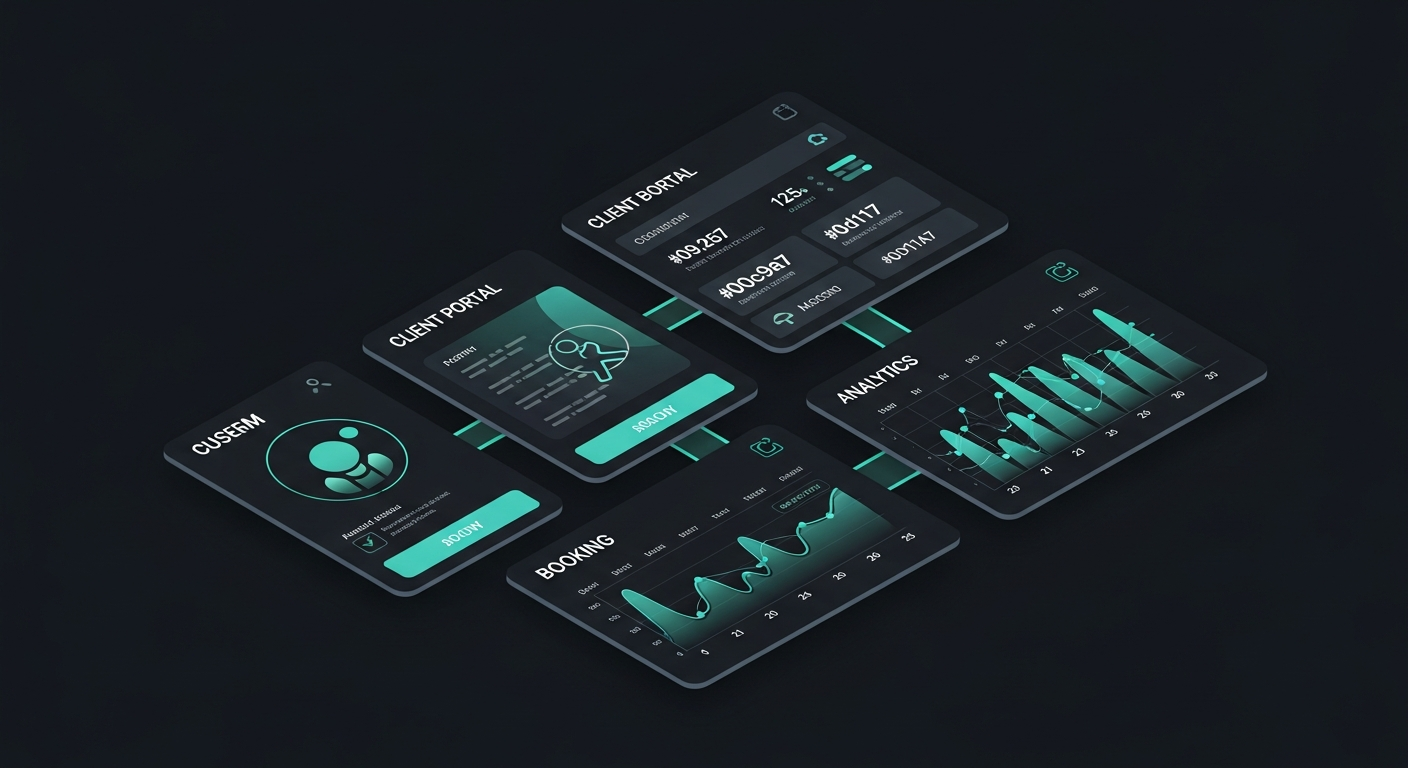
A service business was using Calendly for scheduling, HubSpot for their CRM, Google Sheets for job tracking, and Mailchimp for follow-up emails. Four platforms, four logins, four monthly bills, and a lot of manual copy-paste in between. We built them a single application that handles booking (with intelligent routing based on service type and technician availability), client management, job tracking from quote to completion, and automated follow-up sequences — all in one interface. Their admin time dropped by 60%, their team stopped losing leads in the handoff between systems, and their monthly software cost actually decreased.
A professional services firm had a unique client onboarding process that involved intake forms, document collection, compliance checks, and a multi-step review workflow. They were managing it through email and a shared Google Drive folder. It worked when they had 10 clients a month. At 40 clients a month, it was chaos. We built a client portal that guides each client through the onboarding process step by step, collects documents securely, routes reviews to the right team member, and gives the firm a dashboard showing where every client stands. What used to take 3 hours of admin time per client now takes 20 minutes.
A multi-location retail business needed to track inventory across locations, manage transfer requests, and generate reports that their existing POS system couldn't produce. Instead of replacing their POS (which their team knew and liked), we built a lightweight app that sits on top of it, pulling data via API and providing the visibility and reporting they needed. Total build time: three weeks.
Custom Doesn't Mean Expensive or Slow
This is the biggest misconception about custom software, and it's the one that keeps most businesses stuck with inadequate tools longer than they should be. Custom business apps are not enterprise software projects. They don't require 18-month timelines, million-dollar budgets, or teams of 20 developers.
Modern development approaches mean a focused business app — one that solves a specific, well-defined problem — can be scoped, designed, and shipped in 2-4 weeks. The key is starting with the highest-leverage problem — the one bottleneck that, if solved, unlocks the most value. You don't need to replace every tool you use on day one. You need to solve the most painful problem first, prove the value, and expand from there.
At GrowWithOtter, our custom business app projects range from $5,000 to $15,000 depending on complexity. That covers scoping, design, development, testing, and deployment. We then maintain the application through monthly care plans that include hosting, updates, monitoring, and priority support.
Compare that against the ongoing cost of manual processes, SaaS subscriptions for tools you've outgrown, and the lost productivity from working around software instead of with it. For most businesses at the inflection point we described earlier, a custom build pays for itself within 3-6 months.
What About Maintenance and Updates
One legitimate concern business owners raise about custom software is long-term maintenance. With an off-the-shelf SaaS tool, the vendor handles updates, bug fixes, and new features. With custom software, who does that?
This is where choosing the right development partner matters enormously. A good development partner doesn't just build your app and walk away — they maintain it, monitor it, and improve it over time. At GrowWithOtter, every custom app project includes the option for a monthly care plan that covers hosting, monitoring, security updates, bug fixes, and priority support. Your app stays current and reliable without you having to think about the technical details.
The other concern is flexibility. What if your business changes and you need the app to do something different? This is actually where custom software has its biggest advantage over off-the-shelf tools. With a SaaS product, you're stuck with whatever features the vendor decides to build. If they don't prioritize your use case, you're out of luck. With custom software, you own the code and can modify it to match your evolving needs. Adding a new workflow, integrating with a new tool, or adjusting business logic is a straightforward development task — not a feature request submitted to a vendor who may never get around to it.
The businesses that invest in custom software early — when the pain of workarounds first becomes significant — gain a compounding advantage over competitors who keep patching together generic tools. Every month your purpose-built system runs, your team gets faster, your processes get smoother, and the gap between your operational efficiency and your competitors' widens.
The question isn't whether you can afford custom software. It's whether you can afford to keep patching together tools that weren't designed for how your business actually works.
Ready to put these ideas to work?
Book a $500 AI audit and we'll map out exactly where AI and automation can create the most leverage for your business.
Book an audit →