How AI Chatbots Are Transforming Small Business Customer Service
If you run a small business, you already know the problem: someone visits your website at 9 PM, has a question about pricing or availability, and leaves without converting. No one was there to help. That potential customer is gone — probably to a competitor who answered faster.
This isn't a rare occurrence. It happens every day, on every business website that doesn't have a way to engage visitors in real time. And the financial impact is significant — most businesses don't realize how many leads they're losing simply because no one was available to have a conversation when the prospect was ready.
AI-powered chatbots solve this in a way that used to only be available to enterprise companies with massive customer service budgets. But in 2026, the technology is accessible, affordable, and remarkably effective for businesses of all sizes. And the gap between businesses that use AI chat and those that don't is widening every month.
What Modern AI Chatbots Actually Do
Let's clear up a common misconception first. When most business owners hear 'chatbot,' they think of those annoying pop-ups from five years ago that could barely understand a question and responded with generic, unhelpful answers. Those were rule-based bots — glorified FAQ menus dressed up as conversations. They frustrated users more than they helped.
Modern AI chat widgets are fundamentally different. They're powered by large language models trained on your actual business data — your services, your pricing, your processes, your FAQs, your service areas, even your tone of voice and brand personality. They don't just deflect questions with canned responses. They understand context, handle follow-up questions, and engage in natural conversations that feel like talking to a knowledgeable team member.
Here's what a well-built AI chatbot actually does for a small business:
It answers the repetitive questions your team fields every day. Hours of operation, service areas, pricing ranges, availability, what's included in each service, whether you offer financing, how far in advance they need to book — the questions that take up 60-70% of your inbound communication. Every one of these questions answered by the chatbot is a phone call or email your team doesn't have to handle, freeing them to focus on work that actually requires a human.
For most businesses, this alone cuts inbound call volume by 30-50%. That's not a theoretical number — it's what we see consistently with our clients. Think about what that means for a business that gets 20 calls a day. If the chatbot handles 8 of those, that's 8 conversations your team didn't have to have, 8 blocks of time they can spend on billable work, client service, or closing warm leads.
How Lead Qualification Changes Everything
Answering questions is valuable, but lead qualification is where AI chatbots become genuinely transformative for small businesses. Here's the problem most businesses face: not all leads are equal, but you don't know which ones are worth your time until you've already invested 15-30 minutes in a conversation.
A well-designed AI chatbot qualifies leads in real time by asking the right questions — budget range, timeline, project type, specific needs, location — and scoring each prospect based on their answers. High-quality leads get flagged for immediate follow-up. Lower-quality leads get helpful information but don't consume your team's time.
This isn't cold or impersonal. Done well, the qualification conversation feels natural and helpful to the prospect. They're getting their questions answered and being guided toward the right next step, whether that's booking a call, filling out a detailed intake form, or being directed to a self-service option that fits their budget.
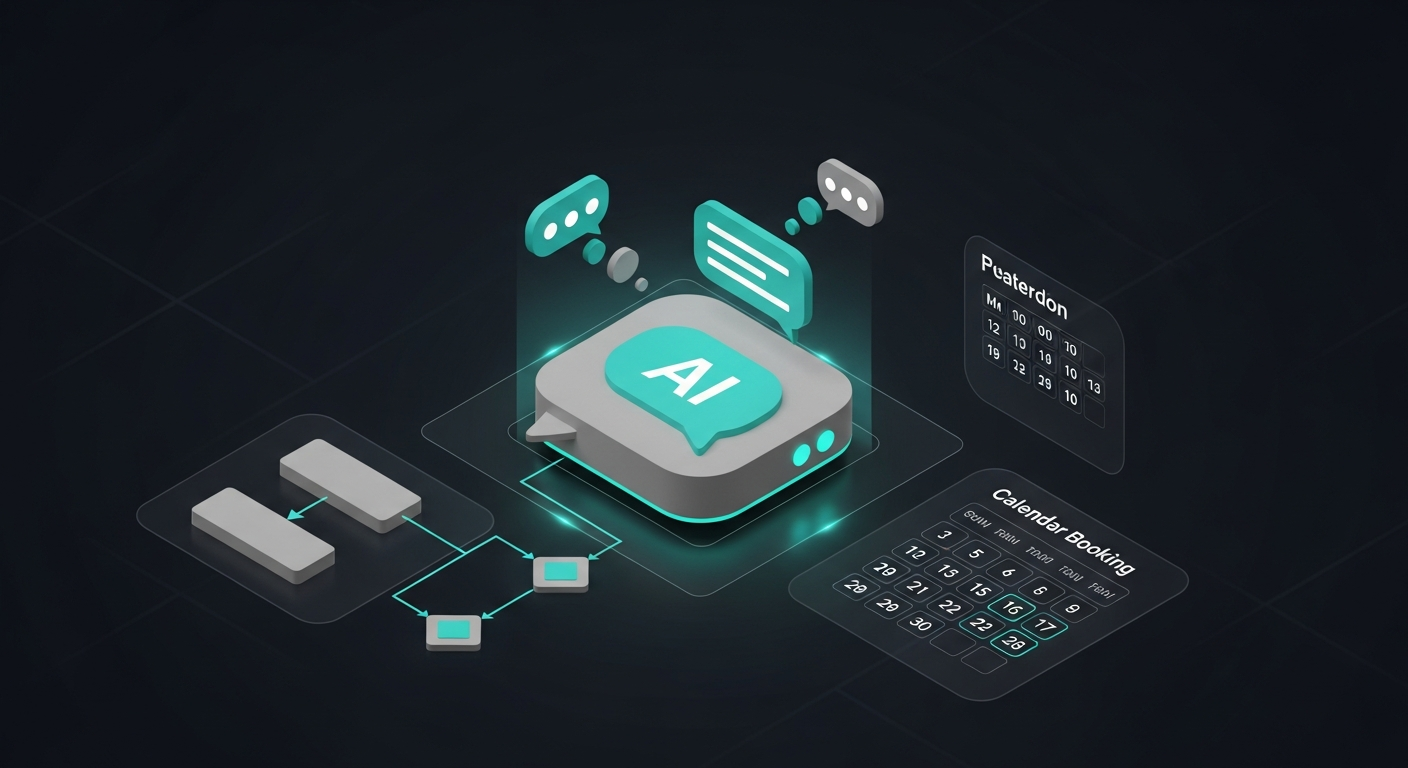
The third major capability — and the one that drives the most direct revenue — is calendar booking. When the chatbot identifies a qualified lead, it can offer to schedule a meeting directly, pulling from your team's real-time availability. No back-and-forth emails. No phone tag. The prospect goes from 'I'm interested' to 'I have a meeting booked' in the same conversation. That reduction in friction is worth more than most business owners realize — every hour of delay between initial interest and booked meeting reduces close rates significantly.
The ROI Math That Makes This a No-Brainer
Let's make this concrete with actual numbers. Say your average project value is $5,000. Your website gets 1,000 visitors per month. Without a chatbot, maybe 2% fill out a contact form — that's 20 leads. Of those, maybe half are qualified, and you close 30% of qualified leads. That's 3 deals per month, or $15,000 in revenue.
Now add an AI chatbot. Because it engages visitors proactively — not waiting for them to find and fill out a form — it captures leads at 2-3x the rate of a static contact form. So instead of 20 leads, you're getting 40-60. The chatbot qualifies them in real time, so your close rate on the leads that reach your team is higher — say 40% instead of 30%, because you're only talking to people who've already been screened.
Run the math: 50 leads, 60% qualified (30 qualified leads), 40% close rate = 12 deals per month = $60,000. Even if you're conservative and cut those numbers in half, you're looking at $30,000 per month versus $15,000 — a doubling of revenue from the same website traffic.
The cost of a well-built AI chatbot? At GrowWithOtter, our AI Website Chat projects range from $2,500 to $5,000 for the initial build, plus a monthly care plan starting at $197. Against even modest revenue increases, the ROI pays for itself many times over in the first month.
Why Training Is Everything
Here's the critical distinction between a chatbot that works and one that actively hurts your business: training quality. A generic chatbot that spits out irrelevant answers, gets confused by simple questions, or gives information that contradicts what's on your website will damage your brand more than having no chatbot at all.
The AI needs to be trained on your specific business. Not just your service list and pricing — but your differentiators, your process, the common objections your customers have, the specific questions that come up in your industry, and the way you talk about your work. A chatbot for a dental practice should sound different from one for a landscaping company. The tone, the vocabulary, the types of questions it anticipates — all of this needs to match your brand.
This is why we build every chatbot from scratch around the specific business it serves. We start with a deep discovery session where we map out every common question, objection, and conversation path. We train the AI on your actual website content, service descriptions, and any documentation you have. Then we test it extensively — not just for accuracy, but for tone, helpfulness, and the quality of the conversation experience.
The difference between a well-trained chatbot and a generic one is the difference between a knowledgeable team member and a confused intern. Both can technically answer the phone, but only one builds trust with your customers.
The 24/7 Advantage
There's one more dimension to this that deserves emphasis: time. Your AI chatbot works at 9 PM on a Tuesday. It works at 6 AM on a Saturday. It works on holidays, during your busiest season, and when your entire team is at an offsite meeting. It never calls in sick, never has a bad day, and never forgets to follow up.
For service businesses where a significant portion of website traffic comes outside business hours — which is most local businesses — this alone represents a massive competitive advantage. The prospect who visits your site at 10 PM and gets an immediate, helpful response is significantly more likely to become a customer than one who sees a contact form and thinks 'I'll call them tomorrow' (and then forgets).
The data backs this up consistently. Studies on website engagement show that response time is the single biggest factor in lead conversion. Leads contacted within 5 minutes are 21x more likely to convert than leads contacted after 30 minutes. An AI chatbot responds in seconds — every time, on every channel, at every hour. No human team can match that consistency.
Implementation: Easier Than You Think
One concern we hear frequently from business owners is that implementing an AI chatbot sounds complicated or disruptive. In reality, the process is straightforward. At GrowWithOtter, a typical chatbot project follows a clear path: we start with a discovery session to understand your business, your common customer questions, and your conversion goals. We then build and train the AI on your specific content — service descriptions, pricing, FAQs, process documentation, and any other materials that help it understand your business deeply.
The chatbot is deployed as a small widget on your website — it doesn't require a redesign or any changes to your existing site. Most implementations go from kickoff to live in 2-3 weeks. Once deployed, the AI continues learning from every conversation, getting more accurate and more effective over time. You can review conversation logs anytime to see exactly what prospects are asking and how the AI is responding.
We also build in escalation paths for situations where a human touch is needed. Complex questions, frustrated customers, or high-value prospects who want to speak with a real person can be seamlessly handed off to your team — with the full conversation history so nobody has to repeat themselves.
At GrowWithOtter, we build AI chat widgets that are custom-trained on your business data and designed to convert. Most of our clients see measurable results within the first 30 days — more leads captured, more meetings booked, and less time spent on repetitive questions. If you want to see what an AI chatbot could do for your specific business, our $500 AI audit is the place to start.
Ready to put these ideas to work?
Book a $500 AI audit and we'll map out exactly where AI and automation can create the most leverage for your business.
Book an audit →