5 AI Automations Every Local Business Should Implement in 2026
When most local business owners hear 'AI,' they think of ChatGPT writing blog posts or robots replacing jobs. The mental image is either a tech company experiment or a science fiction scenario. Neither feels relevant to running a plumbing company, a dental practice, or a restaurant.
But the most impactful AI applications for local businesses are far more practical — and far more profitable — than either of those stereotypes. They're not about replacing people. They're about eliminating the repetitive, time-consuming tasks that prevent your team from doing the work that actually grows your business.
These aren't futuristic experiments. They're proven automations that thousands of businesses like yours are using right now to save 10 or more hours per week, reduce costly errors, and deliver a customer experience that larger competitors can't match. Here are the five that deliver the most value, with specific examples of how each one works in practice.
1. Automated Appointment Scheduling with Intelligent Routing
The problem: Phone tag. A customer calls, you're with another customer, they leave a voicemail, you call back, they don't answer, they call again tomorrow. Meanwhile, the customer who wanted to book an appointment three days from now has already called your competitor and gotten on their calendar.
An AI-powered scheduling system — like OtterBooking (otterbooking.com) — eliminates this entire cycle. Customers can book appointments directly from your website, 24 hours a day. But unlike a basic calendar widget, an AI-powered system adds intelligence to the process.
It can route appointments to the right team member based on service type, expertise, and availability — so the residential plumbing call goes to the residential specialist, not the commercial team. It can ask qualifying questions during booking to ensure the right amount of time is allocated. It can send pre-appointment communications with what the customer needs to prepare. And it can handle rescheduling and cancellations automatically, freeing up slots that would otherwise go unused.
The time savings are substantial. A typical service business spends 5-10 hours per week managing scheduling — answering calls, confirming appointments, handling changes, filling cancellation gaps. An intelligent scheduling system cuts that to near zero, while simultaneously reducing no-shows through automated reminders and improving customer satisfaction by eliminating friction.
2. AI-Powered Review Response and Monitoring
The problem: You know Google reviews matter. They affect your search ranking, your reputation, and the decisions of every potential customer who looks you up. But responding to every review — thoughtfully, promptly, and on-brand — takes time. Especially when you're getting 5-10 reviews per week across Google, Yelp, and Facebook.
AI can manage this entire process while keeping you in control of the things that matter most. For positive reviews, AI can draft personalized, on-brand responses that thank the customer by name, reference their specific experience, and feel genuine — not like a template. Your team reviews and approves with a click, or you can set it to auto-publish positive responses that meet your quality threshold.
For negative reviews, the AI flags them immediately for your personal attention, drafts a professional response for your review, and tracks resolution. The speed matters here — responding to a negative review within 24 hours dramatically changes how other potential customers perceive the situation. A business that responds quickly and professionally to criticism looks more trustworthy than one with all five-star reviews.
Beyond response, AI monitoring can analyze sentiment trends across all your review platforms, alerting you to emerging issues before they become patterns. If three customers mention 'wait times' in the same week, you know about it before it shows up as a star-rating decline.
3. Smart Inventory and Supply Alerts
For retail, restaurants, and service businesses with physical inventory, the cost of getting stock levels wrong goes both directions. Running out means lost sales and disappointed customers. Over-ordering means tied-up capital and waste. Most businesses manage this with manual counts, gut feel, and reactive ordering — which works until it doesn't.
AI can predict when you'll run low on supplies based on historical purchasing patterns, seasonal trends, day-of-week variations, and current booking volume. A restaurant that knows it typically goes through 30% more produce in the week before a holiday can auto-generate an adjusted order three days in advance. A salon that sees a spike in color appointments every March can ensure they're stocked before the rush hits.
The predictions get more accurate over time as the AI accumulates more data about your specific business patterns. After six months, it typically knows your inventory needs better than your most experienced team member — because it's tracking hundreds of variables simultaneously, not relying on memory and approximation.

4. Customer Communication Sequences
From appointment reminders to follow-up surveys to re-engagement campaigns, the lifecycle of customer communication is repetitive, essential, and perfectly suited for AI automation. The key difference between AI-generated communication and traditional email automation is personalization depth.
Traditional automation sends the same reminder to everyone: 'You have an appointment tomorrow at 2 PM.' AI-powered communication can say: 'Looking forward to your consultation tomorrow at 2 PM. Based on what you mentioned when you booked, you might want to bring your current policy documents. Parking is available in the lot on the east side of the building.' It's the same automated message, but it feels like your assistant actually prepared for this specific customer.
This extends across the entire communication lifecycle. Post-service follow-ups can reference what was done and suggest next steps. Re-engagement campaigns can be triggered based on actual customer behavior (last visit was 90 days ago, they typically come every 60) rather than arbitrary time intervals. Birthday messages, anniversary outreach, seasonal reminders — all personalized based on the customer's actual history with your business.
The impact on retention is measurable. Businesses that implement AI-powered communication sequences typically see 15-25% improvements in repeat booking rates. That's not because the technology is magical — it's because consistent, personalized follow-up is one of the highest-ROI activities any business can do, but almost nobody does it manually because it's too time-consuming.
5. Website Chat That Actually Converts
We covered AI chatbots in depth in a separate article, but it bears repeating here because a well-trained AI chat widget is probably the single highest-ROI automation a local business can implement. It works 24/7, never calls in sick, and gets smarter over time.
The reason it belongs on this list alongside the other automations is that it addresses the single biggest leak in most small business marketing funnels: the gap between 'someone visits your website' and 'someone actually reaches out.' For most business websites, fewer than 3% of visitors take any action. An AI chat widget that proactively engages visitors, answers their questions, and guides them toward booking can double or triple that conversion rate.
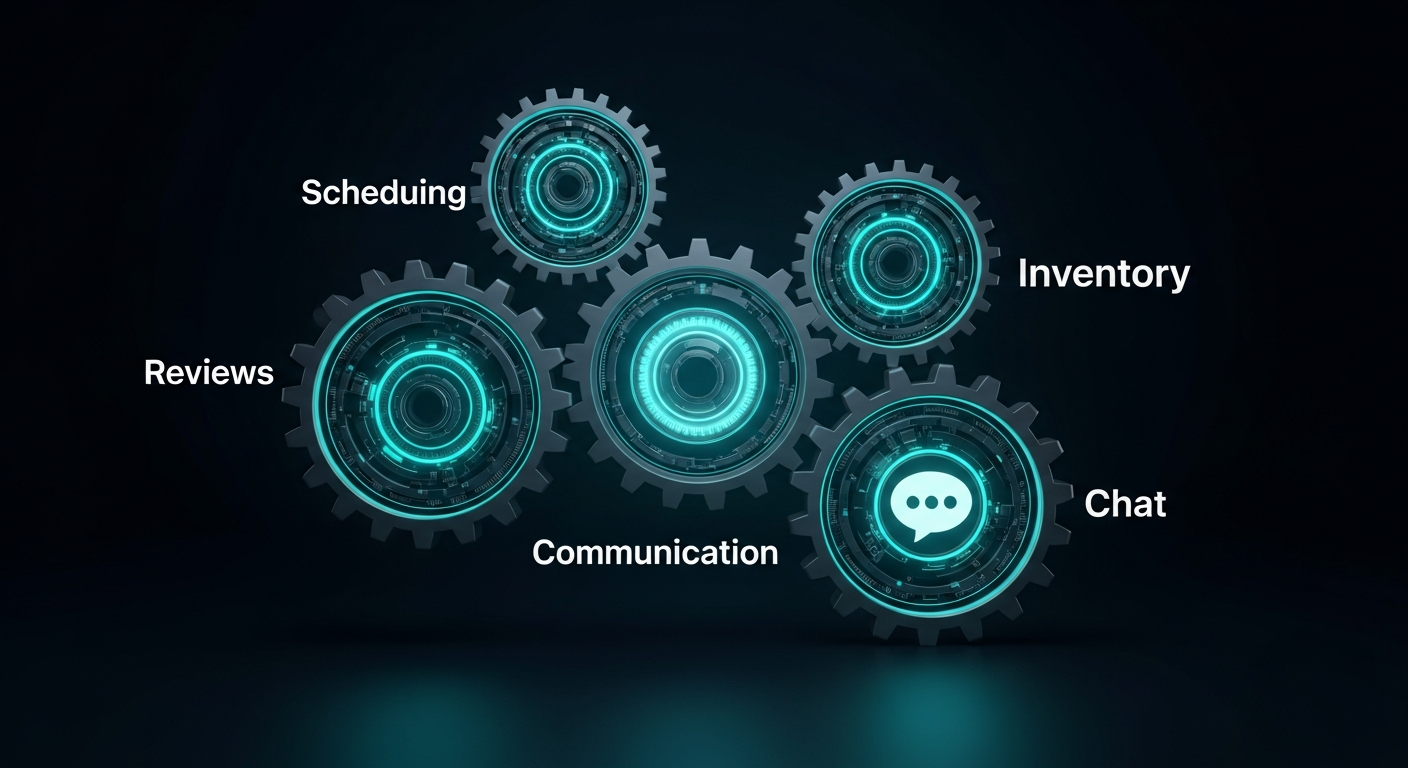
Combined with the other four automations on this list — intelligent scheduling, review management, inventory optimization, and customer communication — AI chat creates a system where your business operates at a level of responsiveness and personalization that used to require a team twice your size.
Getting Started Without Getting Overwhelmed
You don't need to implement all five at once. In fact, you shouldn't. The most effective approach is to identify the single automation that addresses your biggest pain point, implement it well, measure the results, and use the ROI to fund the next one.
For most service businesses, the highest-impact starting point is either scheduling automation (if phone tag and no-shows are your biggest problem) or AI chat (if converting website visitors is your biggest opportunity). For retail and restaurant businesses, inventory optimization often delivers the fastest measurable return.
The Compound Effect of Multiple Automations
Here's what makes AI automation genuinely transformative rather than just incrementally helpful: these five automations don't just save time individually — they compound. When your scheduling is automated and your customer communication sequences are running, you get fewer no-shows because reminders are consistent. Fewer no-shows mean more appointments per week. More appointments mean more reviews (because your review automation catches every customer). More reviews improve your search rankings and AI visibility. Better visibility drives more website traffic. More traffic means more chatbot conversations. More chatbot conversations mean more qualified leads. More qualified leads fill your schedule, and the cycle continues.
This compounding effect is why businesses that implement two or three automations see disproportionately better results than those that implement just one. Each automation removes friction from a different part of your customer journey, and together they create an experience that feels seamless and professional to the customer — even if your team size hasn't changed at all.
The businesses we work with that have implemented three or more of these automations consistently report that they feel like they've added the equivalent of a full-time team member — without the salary, benefits, and management overhead. Their operations run smoother, their customers are happier, and their team can focus on the high-value work that actually requires human judgment and creativity.
What It Actually Costs
The cost of AI automation has dropped dramatically over the past two years. What used to require $50,000 in custom enterprise software development can now be implemented for a fraction of that. At GrowWithOtter, most individual automation projects fall in the $2,500 to $5,000 range, with monthly maintenance starting at $197. For businesses that want to implement multiple automations, we offer bundled packages that reduce the per-project cost further.
At GrowWithOtter, we help local businesses identify and implement the AI automations that will have the biggest impact on their bottom line. Our $500 AI audit maps your current operations and identifies exactly where automation creates the most leverage — not in theory, but based on your actual workflows, volumes, and pain points.
Ready to put these ideas to work?
Book a $500 AI audit and we'll map out exactly where AI and automation can create the most leverage for your business.
Book an audit →